How to prioritize when you have a million things on your plate

Farah K
|
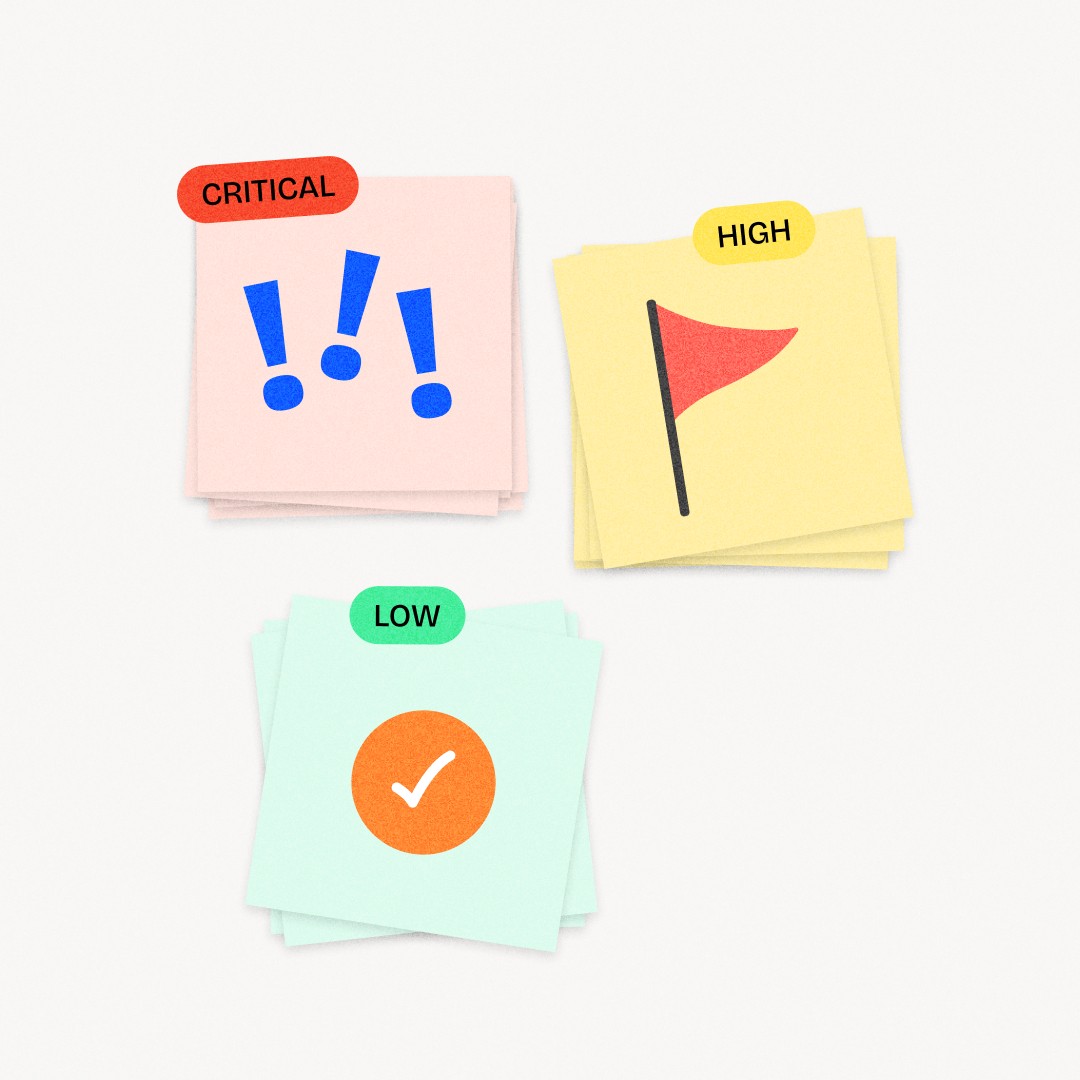
This week, we’re diving into one of the most common questions we hear from Focused Space members: “How do I prioritize my tasks when I have a million things on my plate???”
When you have too many competing priorities, it can be a struggle to know which to do first.
It’s the good ‘ol paradox of choice: we tend to impose higher expectations on ourselves, followed by regret for not accomplishing more or feeling like we wasted time, followed by self-blame. Too many options leads to mental overwhelm and shutdown.
While the ability to prioritize effectively is like a skill — a muscle that we can build over time — it can be uniquely challenging for people with ADHD who might avoid critical tasks by working on other things.
(This is coming from someone who, seven months after moving, chose to finally unbox and detangle every single necklace she owned before filing her taxes!)
At the heart of task overwhelm is often the nervous system — plus a brain constantly chasing dopamine and novelty.
In this guide, we’re sharing some out-of-the-box, fun, and rewarding frameworks for deciding what to tackle first when your plate starts looking like an all-you-can-eat buffet.
Two strategies to help you prioritize
⚖️ Try binary (either/or) decisions.
Pick two tasks on your list and make a simple yes (prioritize)/no (deprioritize) choice.
Which one matters more right now? Move the winner forward and repeat until you’ve gone through your whole list.
Bonus: once you’ve identified your order of operations, make it fun by writing each task on a post-it, and then crumpling it up and throwing it across the room as your way of “crossing it off”.
🗣️ You don’t always have to be “in the mood” to get started.
If your most urgent task is causing high avoidant feelings, acknowledge them out loud. “I really dread opening this document right now, it feels heavy, and that’s okay.”
Naming the friction helps lower your nervous system's defenses so you can take action anyway.
Urgency & Consequences
When everything feels urgent, having a simple system to rank and sequence tasks can bring clarity and reduce a lot of unnecessary stress.
If you’re facing a mile-long to-do list and you don’t know where to start —when everything feels super important and maybe even urgent — we have a strategy you can try out today.
This is a simple system you can use to decide where to start, what to focus on now, and how to avoid major negative consequences while still moving toward your goals.
The first step is to categorize and sequence your to-do list. This will help you stop seeing your to-do list as one insurmountable mountain.
Start by categorizing your tasks into “buckets” by project, goal, or area of life - think professional, academic, personal, household, and social.
Once they’re grouped, put each task attached to a bucket in sequential order.
Don’t worry about importance yet. Just ask, “What needs to happen first, before the next thing can happen?”
This maps out your dependencies and required steps so that you’re not randomly jumping around.
The second step is to score by likely consequence.
Look at your overarching projects and rate them from 1 to 10 on urgency and importance.
If you get a tie — say, two projects both score a perfect 10, you can break the tie by asking yourself, “What is the real consequence or potential negative impact of me not finishing this (or finishing it past the deadline)?”
For example, “If I miss this grant deadline, the team loses funding” would be a high consequence. A low consequence could be, “If I don’t finish this newsletter, it goes out on Tuesday, instead of Monday.”
Seeing the stark contrast in the consequence of not meeting the urgency or deadline makes your immediate focus clear.
Prioritization made easy
🗂️ Step 1: Group tasks into buckets (work, personal, social, etc). Put tasks in order by asking: “What needs to happen first?” (focus on dependencies and required steps).
⚖️ Step 2: Rate projects a score between 1-10 based on urgency (time-sensitivity) and importance (most aligned with your goals). If there’s a tie, ask: “What’s the real consequence if this is late or not done?”
💥 Step 3: Use consequences to break ties and reveal what actually matters most
Prioritization Prompt: What has a real external consequence if I don’t do it soon?
The "Clean Sweep" Protocol
As each week winds down, you may notice there’s always a few lingering items at the bottom of your list that refuse to go away.
In organizational psychology, these are called "open loops” and they’re the tasks you tend to copy over from Monday to Tuesday, then Tuesday to Wednesday, and so on and so forth… until they’re staring at you by the end of the week, still unaddressed.
You aren't actually doing them, but looking at them day after day acts exactly like having 50 background apps open on your phone — they quietly drain your mental battery and spike your background anxiety.
When you have a million things on your plate, you can't afford to let open loops stall your momentum.
That's where the "clean sweep protocol" comes in, to help us get realistic and intentional about our remaining tasks.
Take 5 minutes this morning to look at your stagnant to-dos and make a definitive executive decision: either block out a short window of hyper-focus to cross (or start to cross the task off today)… or, officially offload the stagnant task.
This essentially eliminates the low importance, low urgency tasks for later. Place them in a dedicated “someday” backlog list or folder where they can no longer steal your daily focus.
Sometimes saying ‘no’ and setting a boundary with your own to-do list is the most productive thing you can do — it’s a strategic choice that protects your bandwidth, allowing your nervous system to finally settle down and focus on what’s right in front of you.
3 Steps to Setting Boundaries
🔄 Identify your open loops by ID-ing the items that have been sitting on your list for days or weeks without being touched.
⚡ Try a 15-min power sprint and ruthlessly blast through as much of one avoided task. You may find you’re either able to accomplish it or make enough headway to boost momentum and keep going.
📂 Press the “someday” button: If you realistically aren't going to get to a task this week, remove it from your daily view and file it in a background backlog folder/braindump/out of sight to-do list. Clear your immediate view to clear your mind!
Identify your IBNUs (Important, But Not Urgent)
We’re wrapping up by talking about IBNUs — an acronym coined by ADHD expert and creator Jessica McCabe, that stands for “Important, But Not Urgent.”
For those of us with ADHD, this term can describe the tasks, activities, or entire projects we often don’t get to unless they become urgent, at which point it’s often a crisis.
Common prioritization frameworks, like the Eisenhower Matrix for example, can help you organize tasks by urgency and value, but they often rely on subjective judgment and take real time and patience to map everything out into a neat grid.
It can be important to identify your IBNUs because they tend to be the tasks least likely to get done, even though they’re the tasks that contribute to our success or long-term goals — like filling out a scholarship or grant application for example.
It’s good to recognize your IBNUs as things you’re probably not going to get to “someday” unless you have some support in place.
So, what does that support look like in practice today, even if your tasks don’t have a screaming deadline attached to them yet?
First, give it a mini-deadline: even if it’s artificial. Just thinking about the time estimate, is enough to get curious and less avoidant of the IBNU.
Second, shrink the task into a starting step. Instead of “apply to grant”, jot down the steps necessary to get there. Start with “read grant description”, then “open application", and then "fill one section”, for example.
Third, make it visible. If it lives only in your head or buried in a list, it won’t compete with urgent work.
Try creating a weekly “IBNU happy hour” where you take a closer look at how these align with your goals, or a recurring calendar block called “Future-Me Work."
How to work on your IBNUs
⏰ Add a mini, artificial deadline
✂️ ID the first, easiest micro-step
👀 Find a way to make your IBNU visible — calendar, post-it, mood board, so it doesn’t disappear
✧˖°. ⋆。˚:✧。
Prioritizing is hard, especially when your to-do list keeps growing! We hope this post gives you some new ideas to try to make progress, and get realistic with yourself about what's important.
P.S. If you aren't a member of Focused Space, but could use help accomplishing your goals, busting through procrastination, or getting motivated… you are welcome to join us at one of our live guided work sessions, or morning planning sessions!
Take care,
— Farah and the focused space team